Japan and AI Debt: History Can Teach Us
Updated: Sep 8
Japanese Markets From Different Angles
Look at the chart below. Anyone who started investing in the Nikkei over the last 10-15 years has been given the experience that stocks never go down long. Whether you invested in Japanese stocks in the 80s or not, if you studied the longer-term history of the Nikkei, you would realize that not only did this stock index lose almost 2/3rds of its values as it started the 1990s, but it took 34 years for it to return to its previous all time high. Clearly, this would have changed the mindset of everyone who invested in Japanese stocks between 1990 and 2010.


Now we jump to 2020. Japan’s borrowing costs, like government bond markets across the world, has entered a long-term bond bear market trend. The radical change from the insane policies of “negative interest rates” to where we are today, is certainly impacting costs across Japan, both in the public and private sectors.


The massive devaluation of the yen to the dollar since 2012 is hard to even fathom. So it is no shock that “assistance” showed up to help the yen recently.
“Last week, U.S. Treasury Secretary Bessent joined with Japan’s Ministry of Finance to intervene in currency markets in an effort to boost the yen to levels that Bessent proclaimed would be more appropriate. Bessent decided that markets are not valuing the yen correctly.” [underlining, my own]
Could it be that the 17% drop in the Nikkei (Japan) and the 44% decline in the Kospi (South Korea) in a few week set off an alarm that the “markets are not valuing the yen correctly”?
Apart from the serious problems Japan has today after years and years of trying to “manipulate markets” or like the central bankers when they kicked off “QE to infinity” in 2009, they will never create longer term stability in markets from their actions.
Once you create more and more debt out of thin air so that it can be leveraged in many ways across the global financial system, you only have to look at the numbers and actions of today to see that we learned nothing from our past.
Now let’s take debt to the AI Sector.
Looking Under the AI Sector
I used AI to ask it some questions that relate to debt in the AI sector today.
Here is what I got.

Is this tool for moving “debt and liabilities off its main balance sheet” an issue today, especially in the tech/AI sector?

While the big tech giants have created enormous stock gains, they also have as enormous amount of debt that is “off balance sheet”.
Enron practiced this as well in the 1990s. I am not saying that any of these companies are practicing deceptive practices, only that this same tool lead to investors getting the wrong impression about what was happening with Enron as we started the 21st century. Clearly, investors are not seeing the whole picture when large sums off debt are moved to another entity.

Look at the chart below from The Market Ear. Does it appear that AI financing is too interconnected? With over a trillion and a half of off balance sheet debt ( Special Purpose Vehicles) and private credit in the AI/tech sector, and remembering what happened when the dot.com bubble burst, clearly, I wonder how many investors are considering what is under the stock values of these AI behemoths.


Yet, as I finish this post, I learn that Nvidia has announced that it has $500 billion in funding lined up by backing the funding with its chips.
Nvidia is attempting to turn its artificial intelligence chips into Wall Street’s newest asset class, partnering with six large asset managers on a $500 billion financing push designed to treat compute infrastructure much like commercial real estate, toll roads or other assets to borrow against. [Underlining, my own]
The chipmaker signed memorandums of understanding with Apollo Global Management, Blackstone, BlackRock, Brookfield Asset Management, Goldman Sachs and KKR to establish financing platforms for Nvidia’s customers, the company said Monday in a statement.

If you notice, the financial giants that are backing this $500 billion, are basing their commitment on a non-binding agreement. Now where have we seen this flexible legal maneuver used recently? Hmm?
While Nvidia is seeking to borrow $500 billion to continue to expand compute infrastructure reach, what would happen if China's DeepSeek used Nvidia Chips to move closer to Nvidia's dominance while coming into the global market with a lower price tag? Would this not make all artificial intelligence chips fluctuate like other commodities and markets have always done? What could that do to the pricing of AI services globally?
DeepSeek has said that its latest model can use Huawei chips for inference, the process that allows an AI system to respond more quickly and accurately to users. Inference generally requires less computing power than training, the demanding process of teaching a model how to function. DeepSeek still relied on Nvidia chips to train its system, according to two sources in the semiconductor industry who were not authorised to comment publicly on the matter.
It was not immediately clear how DeepSeek gained access to those chips, though Chinese companies can still remotely use Nvidia chips housed in data centres outside China. DeepSeek did not respond to a request for comment.
Huawei has said that it plans to release a chip for training this year. But it also said that it would take another year after that before its products could match the performance of Nvidia’s current offerings.
One more point. Here are three headlines from Zero Hedge on Tuesday alone. All are pointing to the massive amounts of credit (debt) that has already been taken on in the AI race, and this is BEFORE the recent announcement by Nvidia for an additional $500 billion.


Lastly, there have already been warnings since June that yes, the AI sector stocks and those that support it can drop very quickly, and this after enormous returns since 2025.


[For the record, Nvdia reports its next earnings on August 26th]
Wrap Up
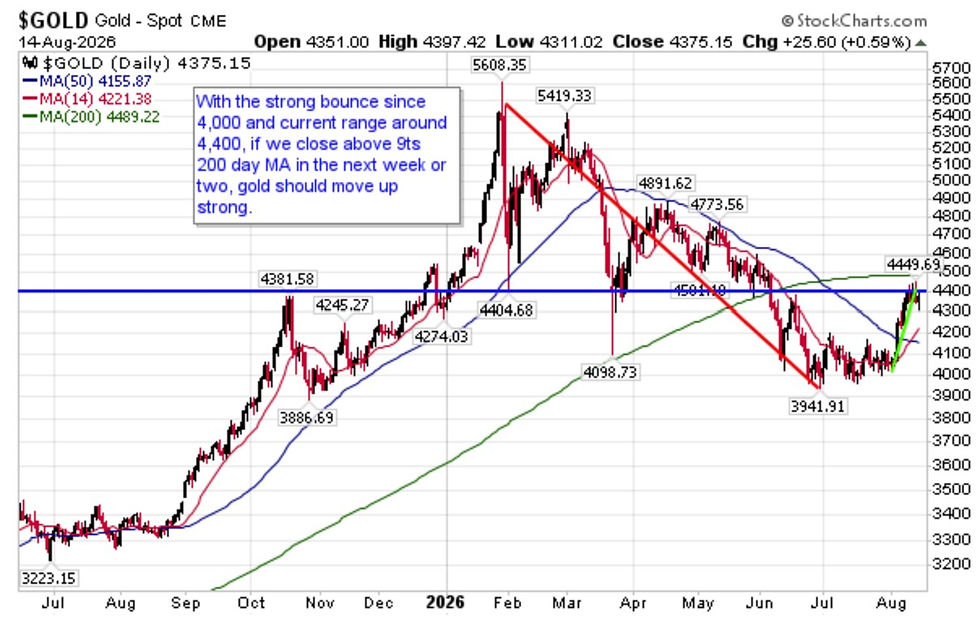
Based on the technical pictures I see in metals, oil, and stocks, I continue to follow a long/short (inverse) strategy as shown in the June post, What Do Climbers Do at Market Peaks?
Once again, each person must make their own decisions, and I offer no investment advice. However, after writing about markets since 2005, I must write and share some of my thoughts and pictures I see unfolding. We are both walking through these historic events together.


I also wish to share today 2 sources I pay for that have been helpful. I do not receive any compensation from them and take no “referral discounts”. Both men have decades of experience at the highest levels of financial markets.
I am also not responsible for any recommendation or commentary you receive from these two men. Like I have stated many times, you are responsible for making your own decisions.
Jim Rickards with Paradigm Press – (constant marketing. The least cost newsletter)
Mike Davis with No Count, Stay Out – (no marketing)
Disclaimer: Best Minds Inc was closed in 2018. I am retired. Nothing I am writing should be taken as advice to buy or sell any form of security or asset. Everyone must study and consider their own situation before putting money anywhere, as well as understand that they are living in a time where major changes at the highest levels of money are taking place. These writings are free.


Comments